Consider the sequence g0 = 0, g1 = 1, g2 = 1/2, g3 = 13/36, g4 = 17/72, g5 = 205/1296, g6 = 91/864, g7 = 3277/46656,... whose linear generator is gn+2 = gn+1/2 + gn/9, that is, the next element is a (1/2,1/9)-weighted sum of the previous two.
- As we did for the Fibonacci numbers, please derive a closed form expression for gn.
- Consider the sequence hn = 6n–1 gn: 0, 1, 3, 13, 51, 205, 819, 3277,... Please give a second order homogeneous linear recurrence with constant coefficients for hn and prove that your recurrence is correct for all n. The recurrence proves 6n–1 gn are integers.
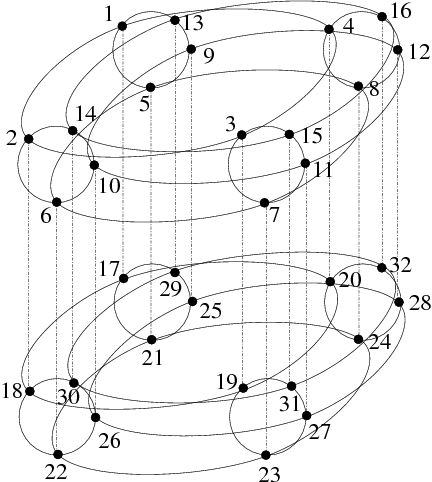
Consider the 5-dimensional hypercube as presented in class. In class the vertices were the integers from 1 to 32. The task is to relabel the vertices in the drawing as strings of 5 bits (5-bit binary numbers) in such a way that the Hamming distance between adjacent vertices is exactly one.
Consider the r-dimensional de Bruijn digraph with 2r vertices and 2r+1 arcs. Like in the hypercube, the vertices are strings of r bits. There is an arc from each vertex i1, i2,..., ir, where ij is either 0 or 1, to the vertex 0, i1, i2,..., ir-1 and an arc to the vertex 1, i1, i2,..., ir-1
- Draw a nice picture of the digraph for r = 3.
- Prove that for r = 4 the digraph has the same diameter as the 4 dimensional hypercube, that is, the maximum distance between two vertices is 4. Your argument must both show that between any two vertices there is a path of length no more than 4, and that there exist two vertices whose distance is at least 4.